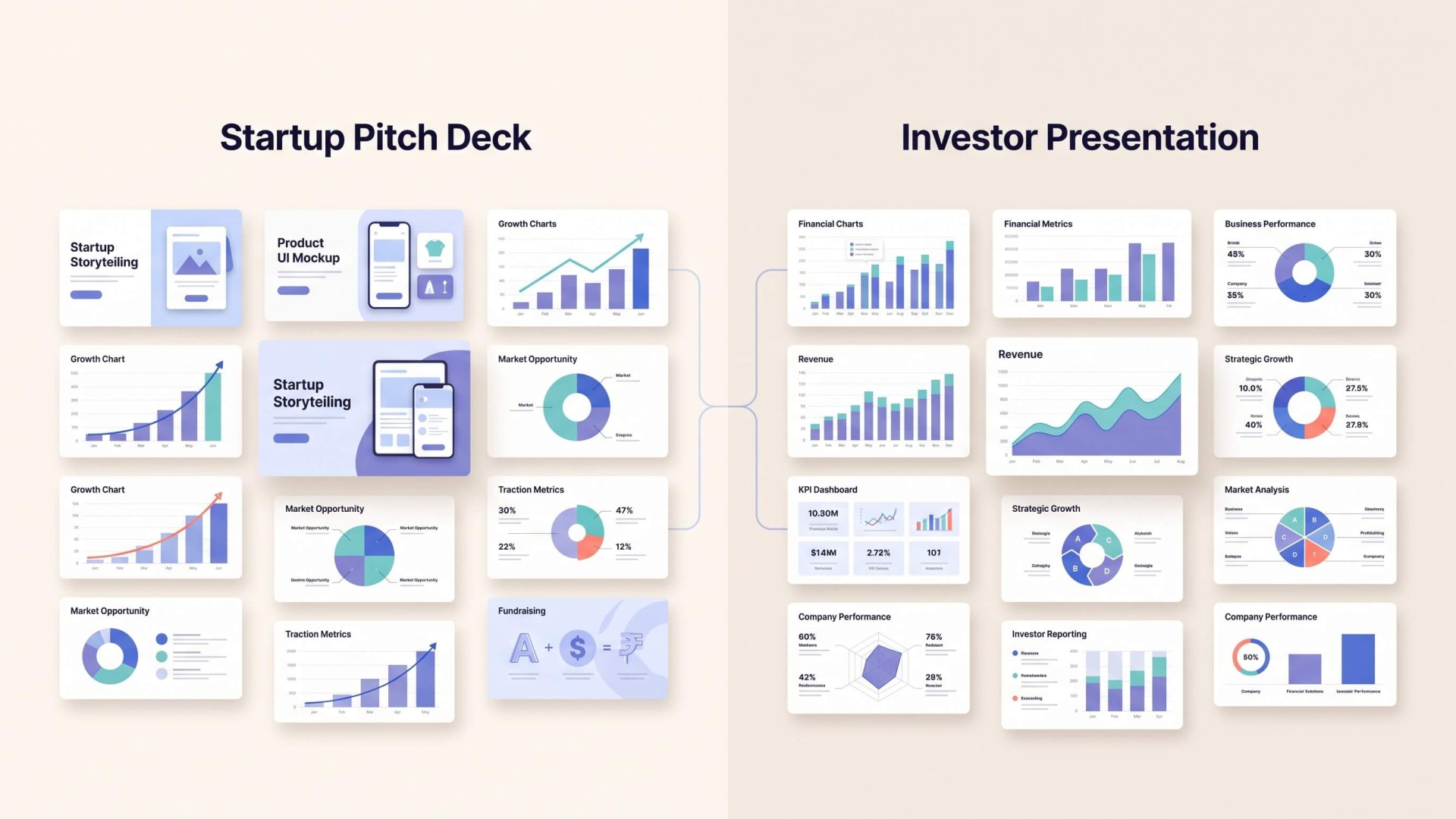
The terms startup pitch deck and investor presentation are often used interchangeably, but they do not always mean exactly the same thing.
Both are designed to communicate a business opportunity to investors or other stakeholders. However, they can differ in purpose, audience, level of detail, and how the information is presented.
Understanding the difference can help founders choose the right presentation format for a fundraising meeting, investor introduction, demo day, or follow-up discussion.
In simple terms, a startup pitch deck is usually a concise presentation built around a startup's story and investment opportunity, while an investor presentation can refer to a broader range of presentations used to communicate financial, strategic, or business information to investors.
Let's break down the difference.
What Is a Startup Pitch Deck?
A startup pitch deck is a presentation created to communicate a startup's business opportunity, typically to potential investors.
It usually tells a structured story:
Problem → Solution → Market → Business Model → Traction → Team → Funding Ask
The goal is to give an investor enough context to understand the company and determine whether they want to continue the conversation.
A startup pitch deck commonly includes:
- Company introduction
- Problem
- Solution
- Product
- Market opportunity
- Business model
- Traction
- Competition
- Competitive advantage
- Go-to-market strategy
- Team
- Financial information
- Funding requirements
The exact structure can change depending on the startup's stage and fundraising situation.
An early-stage startup with no revenue, for example, may emphasize the problem, product, market, and early validation.
A startup with significant revenue may spend more time on traction, unit economics, growth, and financial performance.
What Is an Investor Presentation?
An investor presentation is a broader term for a presentation created specifically for investors or shareholders.
It can include a startup pitch deck, but it can also refer to presentations used by established companies.
For example, an investor presentation might cover:
- Quarterly financial performance
- Annual results
- Business strategy
- Growth plans
- Market conditions
- Product updates
- Corporate strategy
- Mergers and acquisitions
- Capital allocation
- Investor events
This means an investor presentation does not necessarily have to be a fundraising pitch.
A public company, for example, may publish an investor presentation explaining its latest financial results and strategic direction.
A startup raising its first funding round, on the other hand, may use a startup pitch deck as its primary investor presentation.
Startup Pitch Deck vs Investor Presentation
The easiest way to understand the distinction is to think about scope.
A startup pitch deck is generally a specific type of investor-facing presentation.
An investor presentation is a broader category that can cover many different investor communication needs.
| Aspect | Startup Pitch Deck | Investor Presentation |
|---|---|---|
| Primary purpose | Present a startup and investment opportunity | Communicate business, financial, or investment information |
| Typical audience | Potential investors, VCs, angels | Investors, shareholders, analysts, financial stakeholders |
| Storytelling | Usually highly narrative | Can be narrative or data-driven |
| Business stage | Commonly startups and growth companies | Startups, private companies, and public companies |
| Main focus | Problem, solution, market, traction, opportunity | Performance, strategy, financials, growth, or fundraising |
| Length | Often concise | Can vary considerably |
| Funding ask | Common | Optional |
| Product explanation | Usually important | Depends on the purpose |
The two formats can overlap significantly.
A startup pitch deck used during a fundraising process can effectively function as an investor presentation.
However, not every investor presentation is a startup pitch deck.
When Should You Use a Startup Pitch Deck?
A startup pitch deck is particularly useful when you need to introduce your company to someone who does not know the business yet.
Common situations include:
Fundraising Meetings
When approaching angel investors or venture capital firms, your pitch deck provides a structured overview of the opportunity.
The presentation should help investors quickly understand:
- What problem you solve
- Who your customers are
- What you have built
- How large the market is
- How you make money
- What traction you have
- How much you are raising
Demo Days
Startup accelerators and incubators often give founders only a few minutes to present.
In this situation, the pitch deck needs to communicate the core story quickly.
The slides should support the spoken presentation rather than becoming a document that the audience has to read independently.
Investor Introductions
A concise startup pitch deck can also be useful when sending an initial presentation to a potential investor.
In this case, the deck should provide enough information to create context without attempting to answer every possible question.
Fundraising Follow-Ups
After an initial meeting, investors may ask for additional information.
The original pitch deck can become the foundation for a more detailed investor presentation containing additional metrics, financial information, or business details.
When Should You Use an Investor Presentation?
An investor presentation is more appropriate when the purpose goes beyond introducing a startup.
For example, an established company may use an investor presentation to explain its latest financial performance.
A presentation might include:
- Revenue growth
- Profitability
- Cash flow
- Business segments
- Market expansion
- Strategic initiatives
- Capital expenditure
- Future plans
The audience may already understand the company, so the presentation can spend less time explaining the basic business model.
This is one of the biggest differences between a typical startup pitch deck and an investor presentation for an established business.
The Difference in Storytelling
Storytelling is particularly important in a startup pitch deck.
A startup often has limited historical data.
Instead of relying entirely on financial performance, the presentation needs to explain why the opportunity exists and why the company is positioned to pursue it.
A typical narrative might look like this:
1. The Problem
A specific customer problem exists.
2. The Solution
The startup has developed a solution to address that problem.
3. The Market
The problem represents a meaningful market opportunity.
4. The Business Model
The startup has a way to turn customers into revenue.
5. The Traction
Early evidence demonstrates that customers are responding to the product.
6. The Team
The founders and team have relevant capabilities.
7. The Funding Ask
The company needs capital to reach specific milestones.
This narrative structure makes a startup pitch deck feel more like a story.
An investor presentation, particularly one focused on financial reporting, may instead be organized around metrics, business segments, and strategic updates.
The Difference in Data
Another important distinction is the role of historical data.
A startup pitch deck may have limited historical information.
An early-stage startup might only have:
- Early customers
- User growth
- Pilot programs
- Waitlist numbers
- Revenue experiments
- Product usage
- Customer interviews
As the company grows, the presentation can include more detailed business metrics.
An investor presentation for an established company may include several years of:
- Revenue
- Gross margin
- Operating expenses
- EBITDA
- Cash flow
- Customer growth
- Segment performance
The amount of data should therefore reflect the company's stage and the purpose of the presentation.
Startup Pitch Deck vs Pitch Deck
There is also a subtle difference between the terms startup pitch deck and pitch deck.
"Pitch deck" is a general term.
A pitch deck can be created for:
- Startups
- Agencies
- Products
- Sales proposals
- Partnerships
- Fundraising
- Business plans
A startup pitch deck is more specific.
It is generally designed around communicating the opportunity behind a startup.
For example, a sales pitch deck might focus on:
Customer Problem → Product → Features → Benefits → Pricing → Call to Action
A startup fundraising deck might focus on:
Problem → Solution → Market → Business Model → Traction → Team → Funding
The format may look similar, but the underlying objective is different.
What Should a Startup Pitch Deck Include?
If your goal is fundraising, a practical startup pitch deck can include the following slides:
1. Cover
Introduce the company with a clear name, tagline, or one-sentence description.
2. Problem
Explain the customer problem and why it matters.
3. Solution
Show how your product addresses the problem.
4. Product
Use screenshots, diagrams, or product visuals to demonstrate the experience.
5. Market
Explain the target market and opportunity.
6. Business Model
Show how the company generates revenue.
7. Traction
Present measurable evidence of progress.
8. Go-to-Market
Explain how you acquire and retain customers.
9. Competition
Show the competitive landscape and relevant alternatives.
10. Competitive Advantage
Explain what gives your company an advantage.
11. Team
Highlight the experience relevant to building the company.
12. Financials
Show important financial metrics and projections where appropriate.
13. Funding Ask
Explain how much capital you are raising and what it will be used for.
14. Closing
End with the company's vision, key message, or contact information.
You do not have to use every slide.
The best structure depends on the company, fundraising stage, audience, and presentation format.
How to Choose the Right Presentation Format
Ask one question before designing your presentation:
What does the audience need to understand or decide after seeing this presentation?
If you are introducing a new startup to potential investors, a startup pitch deck is usually structured around the investment story.
If you are reporting the company's financial performance to existing investors, an investor presentation may need significantly more financial and operational information.
If you are presenting your product to a potential customer, a sales pitch deck may be more appropriate.
The same company can therefore have several different presentation decks.
Design Matters, But Structure Comes First
A professionally designed presentation can make information easier to understand, but design should support the story.
Start by deciding:
- What is the main message?
- What does the audience need to know?
- Which information is essential?
- Which information belongs in supporting materials?
- What should the audience remember after each slide?
Then design the presentation around those answers.
For a startup pitch deck, visual consistency is particularly important because the presentation often needs to communicate a large amount of information in a limited number of slides.
Use consistent:
- Typography
- Spacing
- Colors
- Charts
- Icons
- Layouts
- Image treatments
A good presentation system allows founders to spend more time refining their story instead of repeatedly rebuilding slide layouts.
Choosing a Pitch Deck Template
Starting with a professionally designed template can make the process considerably faster.
Instead of creating every slide layout from a blank PowerPoint or Keynote document, you can start with predefined layouts for:
- Problem statements
- Product showcases
- Market analysis
- Business models
- Charts
- Financials
- Team profiles
- Timelines
- Funding information
Explore Appiqa's pitch deck templates for presentation layouts that can be customized for startup, business, and fundraising presentations.
For a startup-focused presentation, several options can be adapted to different presentation styles and fundraising scenarios.
The DIGIT Startup Business Fundraising Presentation Template is designed around startup and fundraising presentations, making it suitable for founders building an investor-focused deck.
The PitchUp Professional PowerPoint and Keynote Pitch Deck Template provides a broader pitch deck system that can be customized for different business presentation requirements.
For a more startup-specific visual direction, the Pitch23 Startup Pitch Deck Presentation can be used as a starting point for organizing startup ideas, business information, and fundraising content.
The important thing is to treat a template as a framework—not a substitute for the business story.
Final Takeaway
The difference between a startup pitch deck and an investor presentation is mainly about scope and purpose.
A startup pitch deck is typically a concise, story-driven presentation designed to communicate a startup's business and investment opportunity.
An investor presentation is a broader term that can cover fundraising, financial reporting, strategic updates, business performance, and other investor communications.
In practice, the two formats can overlap.
If you are a founder raising capital, start with the fundamentals:
Problem → Solution → Market → Business Model → Traction → Team → Funding Ask
Then adapt the presentation based on your audience and the stage of your company.
A clear structure, relevant evidence, and consistent visual design will make it easier for your audience to understand the opportunity and give you a stronger foundation for the conversation that follows.
Ready to build your presentation? Browse Appiqa's pitch deck templates and choose a presentation framework that fits your startup or fundraising project.