Table of Contents
- What Is a Startup Pitch Deck?
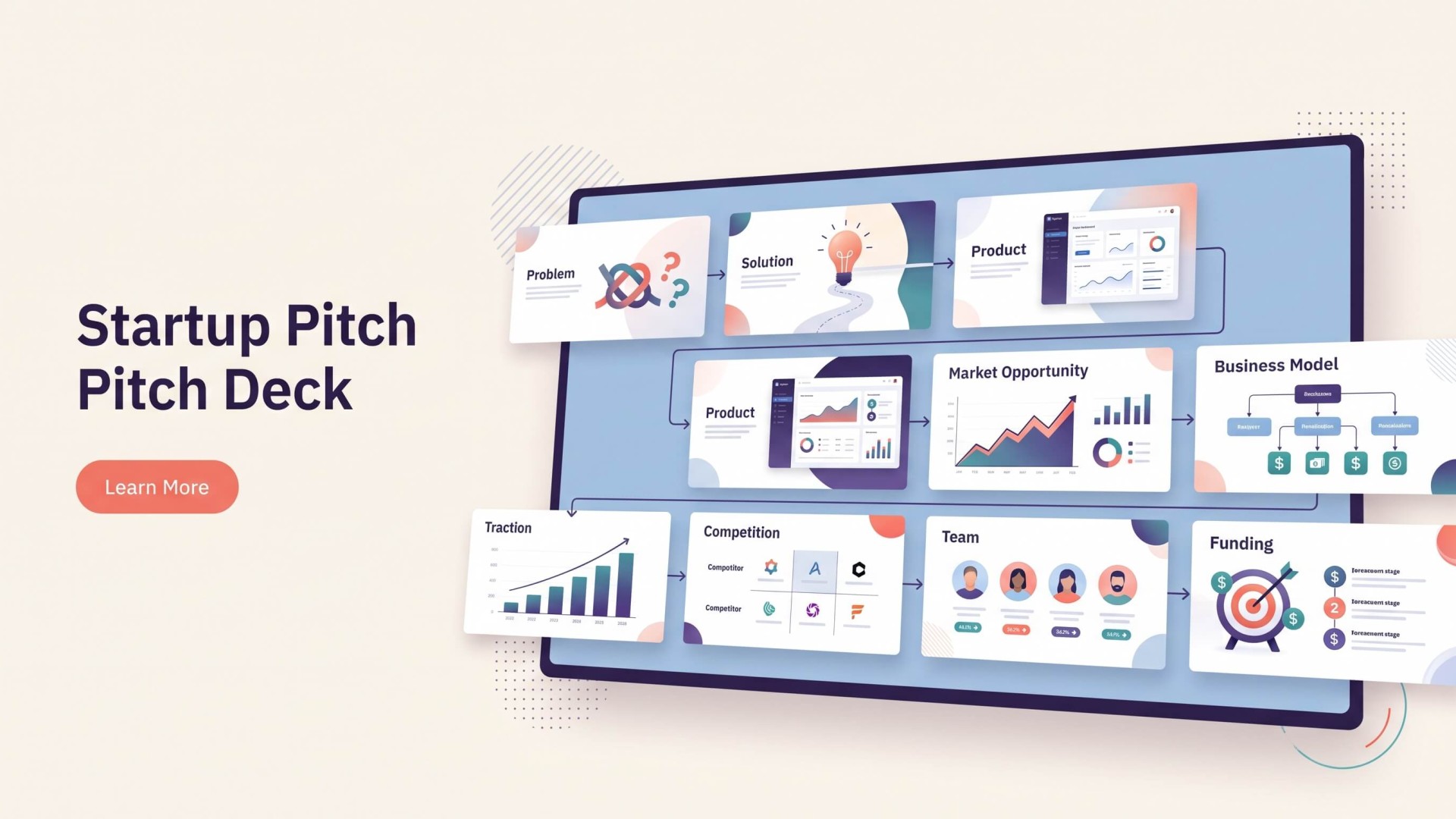
- The Basic Startup Pitch Deck Outline
- 1. Start With a Strong Cover Slide
- 2. Define the Problem
- 3. Present Your Solution
- 4. Show the Product
- 5. Explain the Market Opportunity
- 6. Explain Your Business Model
- 7. Show Traction
- 8. Explain Your Go-to-Market Strategy
- 9. Analyze the Competition
- 10. Highlight Your Competitive Advantage
- 11. Introduce the Team
- 12. Present the Financials
- 13. Make the Funding Ask
- 14. End With a Clear Closing Slide
- How Many Slides Should a Startup Pitch Deck Have?
- The Ideal Pitch Deck Structure
- 1. Context
- 2. Solution
- 3. Opportunity
- 4. Evidence
- 5. Execution
- 6. Investment
- Common Startup Pitch Deck Mistakes
- Too Much Text
- Too Many Features
- Unrealistic Market Numbers
- No Evidence
- Weak Visual Hierarchy
- How to Design Better Pitch Deck Slides
- Start With the Story, Then Design the Slides
- Startup Pitch Deck Checklist
- Final Thoughts
Creating a startup pitch deck from scratch can feel overwhelming. You may have a business idea, a product, early traction, or even a complete business plan—but turning all of that information into a clear presentation is a different challenge.
A strong startup pitch deck is not simply a collection of slides about your company. It is a structured story designed to help investors quickly understand the problem, your solution, the market opportunity, your business model, your traction, and why your team can build the company.
If you are starting from zero, the easiest approach is to follow a proven startup pitch deck outline and build each section around one clear question.
This guide explains how to structure a startup pitch deck from the ground up, what pitch deck slides you should include, and how to organize the information into a compelling investor presentation.
What Is a Startup Pitch Deck?
A startup pitch deck is a presentation used to introduce a startup to potential investors, partners, or other stakeholders.
The primary goal is not to explain every detail of the business. Instead, a pitch deck should create enough clarity and interest for the audience to understand the opportunity and want to learn more.
A typical investor pitch deck includes information such as:
- The problem
- The solution
- The product
- The market opportunity
- The business model
- Traction
- Competition
- Go-to-market strategy
- Team
- Financial projections
- Funding requirements
The exact number of slides can vary depending on the startup and the purpose of the presentation.
What matters most is the pitch deck structure.
Every slide should have a specific purpose and move the story forward.
The Basic Startup Pitch Deck Outline
If you are creating your first pitch deck, start with this simple structure:
- Cover
- Problem
- Solution
- Product
- Market Opportunity
- Business Model
- Traction
- Go-to-Market Strategy
- Competition
- Competitive Advantage
- Team
- Financials
- Funding Ask
- Closing
You do not necessarily need all 14 slides.
Some startups combine sections, while others require additional slides for metrics, technology, regulatory considerations, or business strategy.
The important thing is to create a logical progression from problem → solution → opportunity → execution → investment.
1. Start With a Strong Cover Slide
The first slide should immediately tell the audience what your startup does.
Keep it simple.
Your cover slide can include:
- Startup name
- Logo
- Short tagline
- One-sentence description
- Presenter name and contact information
Avoid filling the first slide with unnecessary information.
A good pitch deck cover should answer one basic question:
What is this company?
For example:
AI-powered financial management for small businesses.
That is much more useful than a vague tagline such as:
Building the future of finance.
The first slide establishes the context for everything that follows.
2. Define the Problem
Once the audience understands what your company is, explain the problem you are solving.
A strong problem slide should make the audience understand:
- Who experiences the problem?
- What is the problem?
- How frequently does it happen?
- Why does it matter?
- What happens if the problem is not solved?
Avoid describing the problem entirely from the company's perspective.
Instead, focus on the customer's experience.
For example:
Small businesses lose hours every week manually reconciling invoices, payments, and expenses across multiple platforms.
A specific problem is easier to understand than a broad statement such as:
Financial management is complicated.
If possible, support your problem statement with relevant data, customer research, or a meaningful statistic.
3. Present Your Solution
After establishing the problem, introduce your solution.
This slide should make the connection between the problem and your product obvious.
A simple structure is:
Problem → Solution → Outcome
For example:
Businesses struggle to reconcile financial data across multiple platforms. Our platform automatically connects transactions, invoices, and expenses into a single financial workspace.
Keep the explanation concise.
You do not need to explain every feature yet.
The goal of this pitch deck slide is to make the audience understand how your startup solves the problem.
4. Show the Product
Now show the actual product.
This is where screenshots, product interfaces, workflows, diagrams, or product demonstrations can become extremely useful.
A product slide can include:
- Product screenshots
- Key features
- User workflow
- Before-and-after comparison
- Product architecture
- Short demonstration
Do not show ten screenshots without context.
Instead, highlight the product experience that directly connects to the problem introduced earlier.
A good product slide should answer:
What does the customer actually use?
If your product is complex, consider splitting this section into two or three slides rather than trying to explain everything on one page.
5. Explain the Market Opportunity
Investors need to understand whether the problem represents a meaningful business opportunity.
This is where you introduce the market.
Common metrics include:
- TAM — Total Addressable Market
- SAM — Serviceable Available Market
- SOM — Serviceable Obtainable Market
However, avoid presenting large market numbers without explaining how they relate to your actual business.
A strong market opportunity slide connects:
Target customer → Market size → Business opportunity
If possible, explain how your market estimate was calculated.
Credible assumptions are more valuable than an impressive but unexplained number.
6. Explain Your Business Model
Your audience should understand how the startup makes money.
Depending on your business, this could involve:
- Subscription
- Transaction fees
- Marketplace commissions
- Licensing
- Usage-based pricing
- Advertising
- Enterprise contracts
- Freemium conversion
For a SaaS startup, for example, you might show:
Free → Pro → Business → Enterprise
You can also include important metrics such as:
- Average revenue per customer
- Customer acquisition cost
- Lifetime value
- Gross margin
- Monthly recurring revenue
The objective is simple:
How does this company turn customers into revenue?
7. Show Traction
Traction is one of the most important parts of an investor pitch deck.
If you already have customers or users, demonstrate measurable progress.
Potential traction metrics include:
- Revenue
- Monthly recurring revenue
- Number of customers
- Active users
- Growth rate
- Retention
- Conversion rate
- Partnerships
- Downloads
- Transaction volume
Instead of simply writing:
We have strong growth.
Show the actual numbers.
For example:
$120K ARR
2,400 paying customers
18% month-over-month growth
Use charts where they help communicate momentum.
If you are pre-revenue, traction can also include:
- Product development
- Beta users
- Letters of intent
- Pilot customers
- Partnerships
- Waitlist growth
- Customer interviews
- Early engagement
The key is to show evidence that the startup is moving forward.
8. Explain Your Go-to-Market Strategy
A great product does not automatically become a great business.
Your pitch deck should explain how you plan to acquire customers.
Your go-to-market strategy might include:
- Content marketing
- SEO
- Paid acquisition
- Sales teams
- Partnerships
- Influencer marketing
- Product-led growth
- Community
- Marketplaces
- Referral programs
Explain which channels you are using and why they make sense for your target market.
9. Analyze the Competition
Every serious startup pitch deck should address the competitive landscape.
Do not claim that you have no competitors.
If customers are currently solving the problem using spreadsheets, manual processes, agencies, or another category of software, those are part of your competitive landscape.
A competition slide can compare your company based on relevant dimensions such as:
- Price
- Ease of use
- Automation
- Features
- Distribution
- Target market
- Integration
- Performance
The purpose of the slide is not to make competitors look bad.
It is to explain why your startup has a credible opportunity to win.
10. Highlight Your Competitive Advantage
After showing the competition, explain what makes your startup difficult to replace or replicate.
Your advantage could come from:
- Proprietary technology
- Data
- Network effects
- Distribution
- Brand
- Partnerships
- Switching costs
- Operational expertise
- Unique intellectual property
- Domain expertise
Avoid generic claims such as:
We have the best technology.
Instead, explain what creates the advantage.
11. Introduce the Team
Investors are also investing in the people building the company.
Your team slide should focus on relevant experience.
Include:
- Founder names
- Roles
- Relevant experience
- Previous companies
- Industry expertise
- Notable achievements
You do not need to include every detail from each person's résumé.
Highlight the experience that supports the company's ability to solve the problem.
The team slide should answer:
Why is this team particularly qualified to build this company?
12. Present the Financials
Depending on your stage and fundraising process, your pitch deck may include financial projections.
A financial slide can show:
- Revenue
- Gross margin
- Operating expenses
- EBITDA or operating profit
- Customer growth
- Cash requirements
- Projected runway
For early-stage startups, avoid presenting overly precise five-year forecasts as if they were guaranteed outcomes.
Instead, focus on the major assumptions behind the model.
Investors are often more interested in understanding how the business scales than seeing a perfect-looking spreadsheet.
13. Make the Funding Ask
If the pitch deck is being used to raise capital, clearly state how much funding you are seeking.
For example:
We are raising $2 million to expand the product, grow the sales team, and enter three additional markets.
You can also show how the capital will be allocated.
- 45% Product & Engineering
- 30% Sales & Marketing
- 15% Operations
- 10% Administration
The funding slide should make the connection between:
Capital → Activities → Milestones
14. End With a Clear Closing Slide
Your final slide should bring the story back to the opportunity.
A strong closing slide can include:
- One-sentence company statement
- Key traction metric
- Vision
- Funding ask
- Contact information
Do not introduce completely new information on the final slide.
The closing should reinforce what the audience has already learned.
How Many Slides Should a Startup Pitch Deck Have?
There is no universal number of slides that works for every startup.
However, a concise investor pitch deck often works well with approximately 10–15 core slides.
The ideal number depends on:
- Startup stage
- Fundraising stage
- Presentation duration
- Audience
- Business complexity
- Amount of supporting evidence
A good pitch deck prioritizes clarity over volume.
The Ideal Pitch Deck Structure
1. Context
Cover → Problem
Explain what the company is and why the problem matters.
2. Solution
Solution → Product
Show how the startup solves the problem.
3. Opportunity
Market → Business Model
Explain how large the opportunity is and how the company makes money.
4. Evidence
Traction → Competition → Advantage
Show why the business has a realistic chance of winning.
5. Execution
Go-to-Market → Team → Financials
Explain how the company will scale.
6. Investment
Funding Ask → Closing
Explain what you are raising and what the capital will accomplish.
This structure creates a natural narrative instead of treating each slide as an isolated piece of information.
Common Startup Pitch Deck Mistakes
Too Much Text
A pitch deck is a visual presentation, not a business plan.
Use short statements, numbers, charts, diagrams, screenshots, and visual hierarchy to make the information easier to understand.
Too Many Features
Your audience does not need to see every feature your product has. Focus on the features that demonstrate your solution to the core problem.
Unrealistic Market Numbers
A large TAM does not automatically mean a large business. Explain your target customer and market assumptions instead.
No Evidence
A compelling story without evidence is still just a story. Whenever possible, support claims with revenue, customer numbers, growth, research, usage data, testimonials, or partnerships.
Weak Visual Hierarchy
Even strong content can become difficult to understand when every element on the slide has the same visual weight.
Each slide should have one obvious takeaway.
How to Design Better Pitch Deck Slides
Good pitch deck design is not about adding more decoration. It is about making important information easier to understand.
Use a consistent visual system across the presentation:
- One typography system
- Consistent spacing
- Clear slide titles
- Limited color palette
- Consistent chart styles
- Strong alignment
- Predictable layouts
Most importantly, establish a visual hierarchy.
The audience should immediately know:
What is the main point?
Then:
What evidence supports it?
Then:
What should I look at next?
A professionally designed pitch deck template can help you establish this structure without designing every slide from scratch.
Explore Appiqa Pitch Deck Templates to find presentation layouts that can be customized for startup, investor, and business presentations.
Start With the Story, Then Design the Slides
One of the biggest mistakes founders make is opening PowerPoint or Keynote and immediately designing slides.
Start with the story instead.
Write down:
- What problem are we solving?
- Who has this problem?
- Why is the problem important?
- What is our solution?
- Why is our solution better?
- How large is the opportunity?
- How do we make money?
- What evidence do we have?
- Why can we win?
- What do we need from investors?
Once these questions are answered, turn each answer into a slide.
This makes the presentation much easier to structure.
Startup Pitch Deck Checklist
- Is the startup immediately understandable?
- Is the problem specific?
- Is the solution clear?
- Can the product be understood quickly?
- Is the market opportunity credible?
- Is the business model clear?
- Is there measurable traction?
- Is the go-to-market strategy realistic?
- Are the competitors acknowledged?
- Is the competitive advantage clear?
- Does the team have relevant expertise?
- Are the financial assumptions understandable?
- Is the funding ask specific?
- Does every slide have one clear message?
- Is the deck visually consistent?
Final Thoughts
Creating a startup pitch deck from zero does not require dozens of slides or complicated storytelling.
The most effective pitch decks usually follow a simple principle:
Start with the problem, demonstrate the solution, prove the opportunity, show evidence, and explain why your team can win.
Use the startup pitch deck outline as a starting point, then adapt the number and order of slides to your startup, audience, and fundraising stage.
Your pitch deck should not try to answer every possible question.
Its job is to create enough clarity, credibility, and interest to start the next conversation.
If you are looking for a faster way to build a professional investor presentation, explore Appiqa's pitch deck templates for ready-to-customize presentation layouts designed for startup and business presentations.